
Good Faith Estimate in Medical Billing: What It Is, Who Gets One, and How to Use It
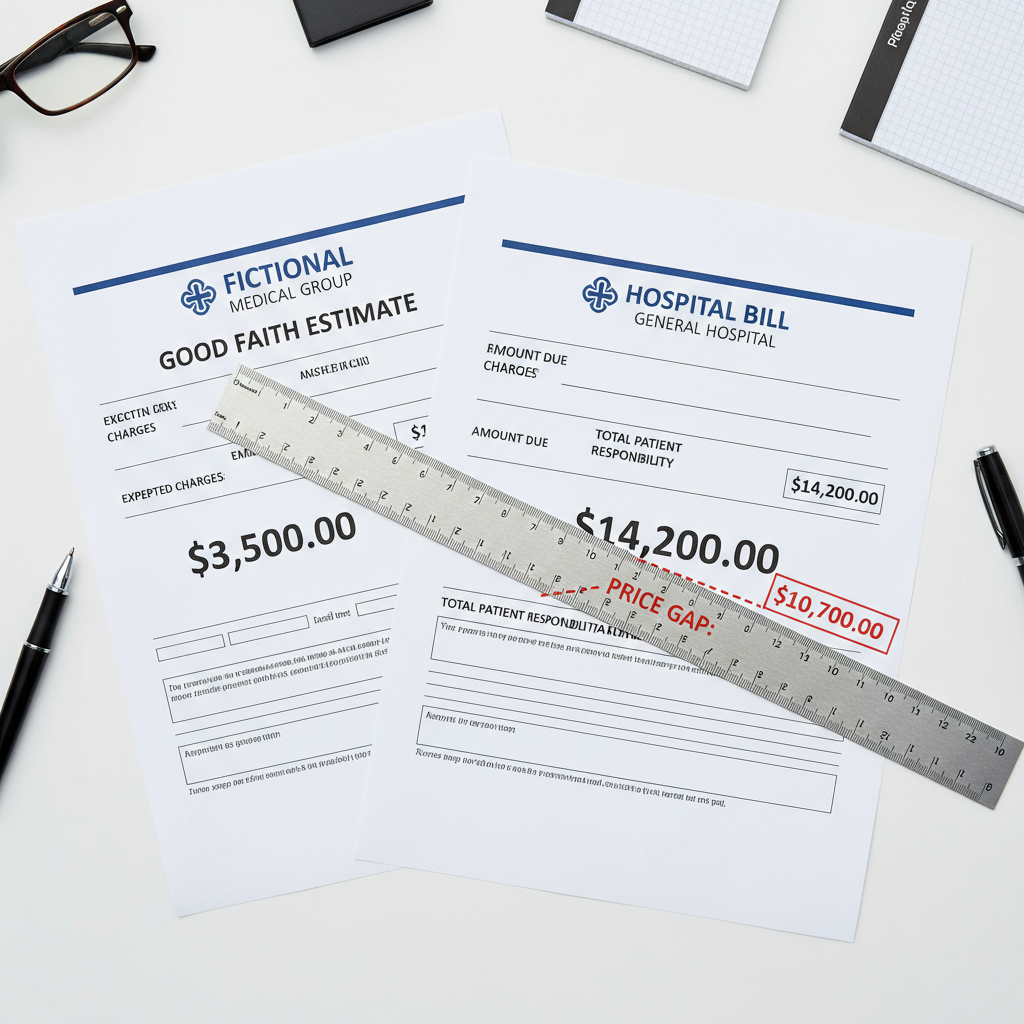
Since January 2022, uninsured and self-pay patients have a federal right to a written cost estimate before scheduled care. If your final bill exceeds that estimate by more than $400, you can challenge it through a formal dispute process — and most patients don't know that protection exists.
Key Takeaways
- The Good Faith Estimate (GFE) requirement applies to uninsured and self-pay patients scheduling non-emergency care
- Providers must issue a GFE automatically or upon request before scheduled services
- If your final bill exceeds the GFE by more than $400, you can initiate a formal federal dispute resolution process within 120 days
- A GFE matching your final bill does not mean the itemized charges are all accurate
- Billyze reviews the itemized charges for potential inconsistencies regardless of whether a GFE was provided
Good Faith Estimate in Medical Billing: What It Is, Who Gets One, and How to Use It
Since January 2022, federal law has required hospitals, surgery centers, and many other providers to give uninsured and self-pay patients a written cost estimate before scheduled care. That document is called a Good Faith Estimate. Most patients have never heard of it. Many who qualify have never received one. And almost none know that if their final bill exceeds it by more than $400, they have a legal right to initiate a formal review process.
What a Good Faith Estimate Actually Is
A Good Faith Estimate (GFE) is a written document a provider must give you before you receive a scheduled service. It details the expected charges for that service — including any items or services reasonably expected to be part of the same episode of care.
The requirement comes from the No Surprises Act, which took effect January 1, 2022. The [No Surprises Act covers a wide range of billing protections](/blog/no-surprises-act-hospital-billing-patient-rights), and the Good Faith Estimate is one of its most underused tools.
The GFE must include:
- The expected charges for the primary service
- Charges for any related items or services from the same provider or facility
- Diagnosis codes (ICD-10), service codes (CPT/HCPCS), and expected billing dates
- A clear statement of your right to request a review if the bill exceeds the estimate
The estimate is not a binding price cap — but it creates enforceable rights if the gap between estimate and final bill is large enough.
Who Is Entitled to a Good Faith Estimate
The Good Faith Estimate requirement, as currently enforced, applies specifically to:
- **Uninsured patients** — those with no health coverage
- **Self-pay patients** — those who have insurance but are choosing not to use it for a particular service
If you have active insurance and plan to use it, the GFE rules work differently. CMS has finalized a parallel framework for insured patients called the Advanced Explanation of Benefits (AEOB), but as of this writing that piece has not been fully implemented.
When Must a Provider Give You One?
For qualifying patients, a provider must issue a Good Faith Estimate:
- **Automatically**, without being asked, when you schedule a service at least three business days in advance
- **Within one business day** if you schedule at least three days out
- **Within three business days** if you schedule at least ten days out
- **Upon request**, at any time, even before scheduling
If a provider fails to issue one when required, that is itself a violation you can report to CMS.
What the Estimate Must Cover
For a hospital procedure, the GFE may include:
- The facility fee for the procedure itself
- Anesthesia (if applicable)
- Lab work ordered as part of the same episode of care
- Imaging
- Any supplies or equipment billed separately
The provider is responsible for coordinating with other providers involved in your care to include their expected charges. In practice, this coordination is often incomplete — which is one reason patients end up with bills that exceed the estimate.
The $400 Threshold and the Review Process
If your final bill from a provider who issued a Good Faith Estimate is more than $400 higher than the estimate for the same items and services, you have the right to initiate a Patient-Provider Dispute Resolution process through CMS.
How it works:
- Initiate the process **within 120 days** of receiving the final bill
- Submit through the CMS dispute resolution portal, along with your Good Faith Estimate and final bill
- A certified resolution entity reviews both documents and issues a binding decision
- The filing fee is currently $25, which is refunded if the decision favors you
The provider cannot send your account to collections while the process is pending.
This is a formal federal mechanism with a structured outcome — but it only applies when you have a GFE in hand and the $400 threshold is met.
Common Situations Where a Good Faith Estimate Becomes Critical
Elective or Scheduled Procedures
If you are scheduling a non-emergency procedure and you are uninsured or self-pay, request a Good Faith Estimate immediately. Do not wait for the provider to issue one automatically.
Ambulatory Surgery Centers
Surgery centers are covered under the same GFE requirements as hospitals. Patients often assume a standalone surgical facility will be cheaper and don't verify the estimate. Understanding [common billing concerns that appear after surgery](/blog/hospital-billing-errors-after-surgery-itemized-bill) is useful context before you go in.
What a Good Faith Estimate Does Not Do
- It does **not** guarantee the final price will match the estimate
- It does **not** currently apply to insured patients using their insurance
- It does **not** cover emergency services
- It does **not** prevent potential billing inconsistencies on the final bill. Even if your bill is within $400 of the estimate, the itemized charges can still contain potential duplicate entries, phantom charges, or inconsistent codes
Receiving a Good Faith Estimate and having it roughly match your final bill does not mean your bill is accurate. It means the top-line number was consistent. The line items underneath still need scrutiny.
For context on how common billing concerns are, [data on hospital billing patterns](/blog/hospital-overcharging-statistics-what-data-shows) is worth reviewing.
Where Billyze Fits In
A Good Faith Estimate gives you a reference point. Your itemized bill gives you the details. Comparing the two line by line — with an understanding of how medical codes work — is where most patients hit a wall.
When you upload your itemized hospital bill, Billyze reviews each charge, flags potential inconsistencies and duplicate line items, and produces a structured informational report. If you also have a Good Faith Estimate, the comparison becomes even more structured — you can see precisely where the final bill diverged.
When findings support a formal communication, Billyze generates an informational letter template ready to send. You are not starting from scratch. You are starting with documentation.
[Upload My Bill — $79](/upload)
The Bottom Line
A Good Faith Estimate is one of the few proactive billing tools federal law gives patients before care begins. If you are uninsured or self-pay and scheduling a procedure, request one in writing. Keep it. Compare it to your final itemized bill when it arrives. If the gap exceeds $400, you have 120 days and a formal federal process available to you.
Even if the top-line numbers match, the itemized charges underneath deserve a close look.
[Upload My Bill — $79](/upload)
Frequently Asked Questions
Related Articles
The No Surprises Act: What It Actually Covers — and Where It Falls Short
The No Surprises Act was designed to end the practice of blindsiding patients with out-of-network bills after in-network…
Hospital Billing Concerns After Surgery: What to Check on Your Itemized Bill
A surgical bill can run dozens of pages. Each page is a separate opportunity for a charge to be inconsistent. Here's wha…
Hospital Billing Inconsistency Statistics: What the Data Actually Shows
The data on hospital billing inconsistencies is consistent and significant. Here's what federal auditors, researchers, a…
Ready for a review of your hospital bill?
Get a full AI-powered review, a line-by-line analysis, and an informational letter template — all for a flat $79.
Upload My Bill — $79